Getting the best value out of fertiliser
Fertiliser is one of the most significant investments on any farm. With input costs remaining high and increasing pressure to improve efficiency, farmers are asking an important question: how do you get the best value from every application?
It sounds straightforward, but the answer is rarely simple. Maximising fertiliser performance requires a clear understanding of soil health, nutrient balance, crop requirements, and field-specific conditions. While this knowledge builds over time, there are practical steps that can deliver immediate benefits – both economically and environmentally.
Why fertiliser efficiency matters
Fertilisers are designed to increase yields, improve crop health, and ultimately enhance returns at harvest. However, not all applied nutrients are used by the crop. Losses through leaching, runoff, and volatilisation can significantly reduce efficiency.
This is not just a cost issue. Nutrient losses can contribute to wider environmental concerns, including water pollution and greenhouse gas emissions. As a result, there is growing focus across the industry on ensuring nutrients are applied precisely and utilised effectively.
Improving nutrient use efficiency means applying the right amount, at the right time, in the right conditions – and crucially, ensuring the soil is in a condition to make those nutrients available.
Start with soil testing
One of the most valuable steps before any fertiliser application is soil testing. Understanding the condition of your soil provides the foundation for informed decision-making.
Soil testing assesses key factors such as nutrient levels, organic matter, and pH. Together, these indicators give a clear picture of soil health and its ability to support crop growth.
Healthy soil delivers multiple benefits:
- Maintains soil structure
- Improves water retention
- Supports stronger crop yields
- Helps resist pests and disease
- Maintains biodiversity
- Contributes to carbon storage
With this information, farmers and agronomists can tailor fertiliser strategies to match crop needs while avoiding unnecessary applications.
The critical role of soil pH
Among all the factors measured in a soil test, pH is one of the most important. It directly influences how effectively crops can access nutrients.
Soil pH measures acidity or alkalinity, with a neutral range of around 6.5–7 generally considered optimal for most crops. Within this range, nutrients are most readily available for plant uptake.
When soil becomes too acidic, nutrient availability drops. Microbial activity – which helps convert nutrients into plant-available forms – is also reduced. This can lead to a situation where fertiliser is applied but not fully utilised.
The impact can be significant. At a soil pH of 5.5, around a third of applied nutrients may be unavailable to the crop. At pH 5.0, losses can rise to around half. In contrast, at an optimal pH, nutrients are far more accessible, improving both efficiency and return on investment.

Moving beyond traditional liming practices
Historically, lime has been applied in large quantities every few years to correct soil acidity. While this approach can raise pH, it often results in fluctuations – with soil moving above and below the optimal range over time.
This means that, in practice, soils may only sit at the ideal pH for a limited period within each cycle.
Modern farming increasingly favours a more precise approach. Rather than applying large amounts infrequently, smaller, targeted applications can help maintain a consistent pH year on year.
This is important because soil pH is not static. It is influenced by factors such as rainfall, crop uptake, fertiliser use, and livestock. Regular adjustment ensures that soil conditions remain optimal for nutrient availability.
Why particle size matters
The effectiveness of lime depends not just on how much is applied, but also on how quickly it reacts in the soil.
Soil acidity is driven by hydrogen ions. When lime is applied, calcium replaces these acidic ions, and the carbonate component neutralises them, forming water and carbon dioxide. This process raises soil pH.
The speed of this reaction is strongly influenced by particle size. Finer particles have a much larger surface area, allowing them to react more quickly with the soil.
Research shows that lime with a high proportion of fine particles delivers faster pH correction. This can be particularly important when addressing acidic soils or maintaining nutrient availability during key growth stages.
How granulated lime supports precision farming
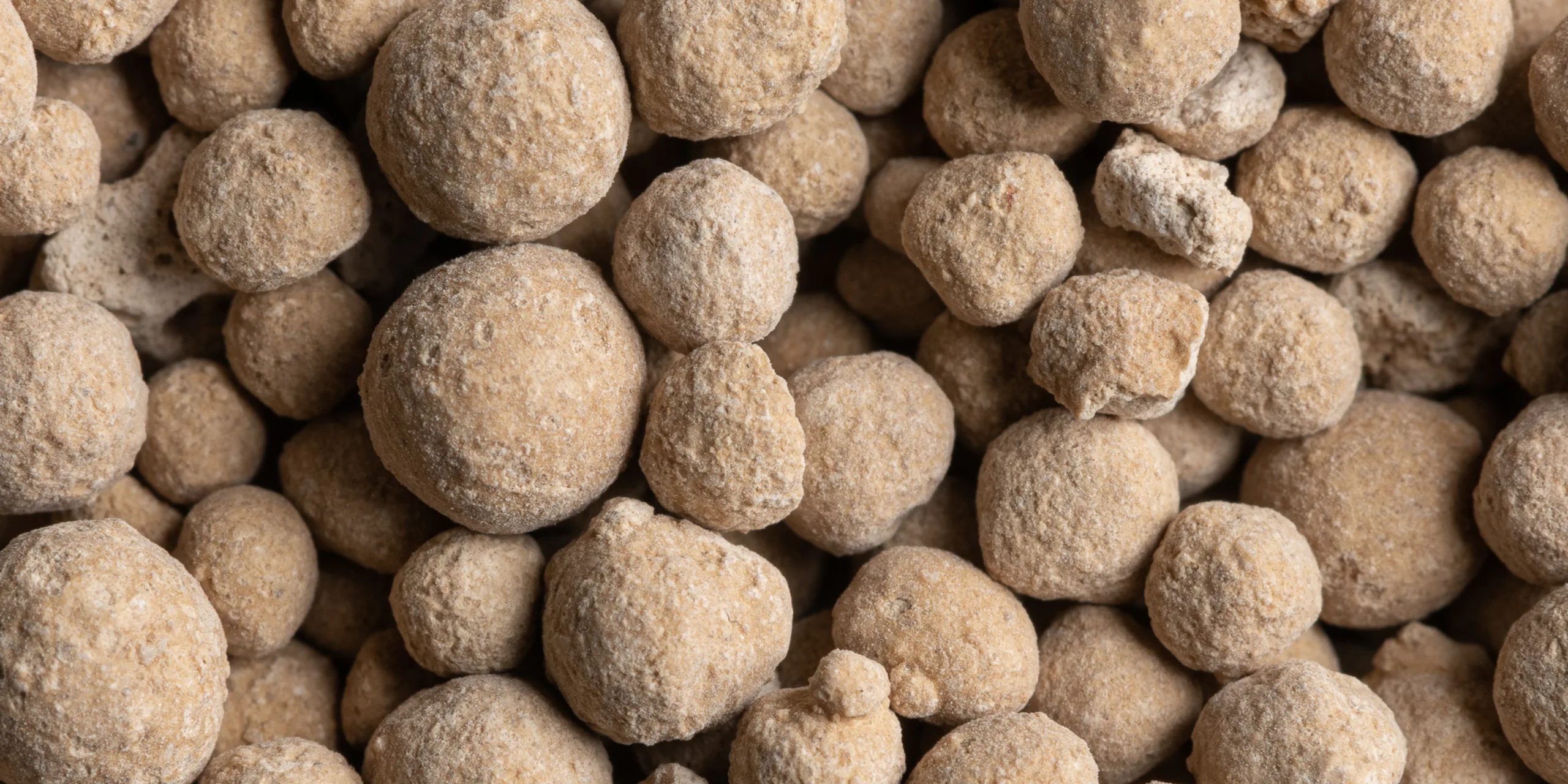
Granulated lime offers a practical solution for maintaining soil pH more precisely. Produced from very fine particles formed into granules, it combines ease of application with rapid reactivity.
When applied, the granules break down on contact with moisture, releasing fine particles into the soil. This significantly increases the reactive surface area, allowing the material to work quickly.
A simple way to visualise this is to imagine a solid cube. Its surface area is limited. Break it into smaller pieces, and the total surface area increases dramatically. The same principle applies to lime – smaller particles mean faster and more effective reaction.
Because of this, granulated lime can be applied at lower rates than traditional agricultural lime, while still delivering a rapid adjustment in pH.
Consistent pH, better nutrient use
Maintaining soil pH within the optimal range is one of the most effective ways to improve nutrient use efficiency. When pH is correct, applied fertilisers are more readily available to crops, reducing waste and improving performance.
Trials have shown that fine, reactive lime products can deliver both rapid correction and a more consistent pH over time. This supports crop growth throughout the season and helps protect the value of fertiliser inputs.
For farmers, this means better yields, improved cost efficiency, and greater confidence that nutrients are being used effectively.
A smarter approach to fertiliser investment
Getting the best value from fertiliser is not just about the product itself – it’s about creating the right conditions for it to perform.
Soil testing, pH management, and precise application all play a role in improving efficiency. By focusing on these fundamentals, farmers can reduce losses, optimise inputs, and achieve more consistent results.
In a landscape where both economic and environmental pressures are increasing, making the most of every nutrient has never been more important.
Supporting better outcomes in the field
At LKAB Minerals, we understand the importance of nutrient efficiency and soil health. Our range of mineral products, including granulated lime solutions, is designed to support farmers in maintaining optimal soil conditions and improving crop performance.
By combining technical expertise with practical solutions, we help ensure that fertiliser investments deliver maximum value – season after season.
To learn more about how our products can support your soil management strategy, get in touch with our team or follow us on LinkedIn for the latest insights and advice.